
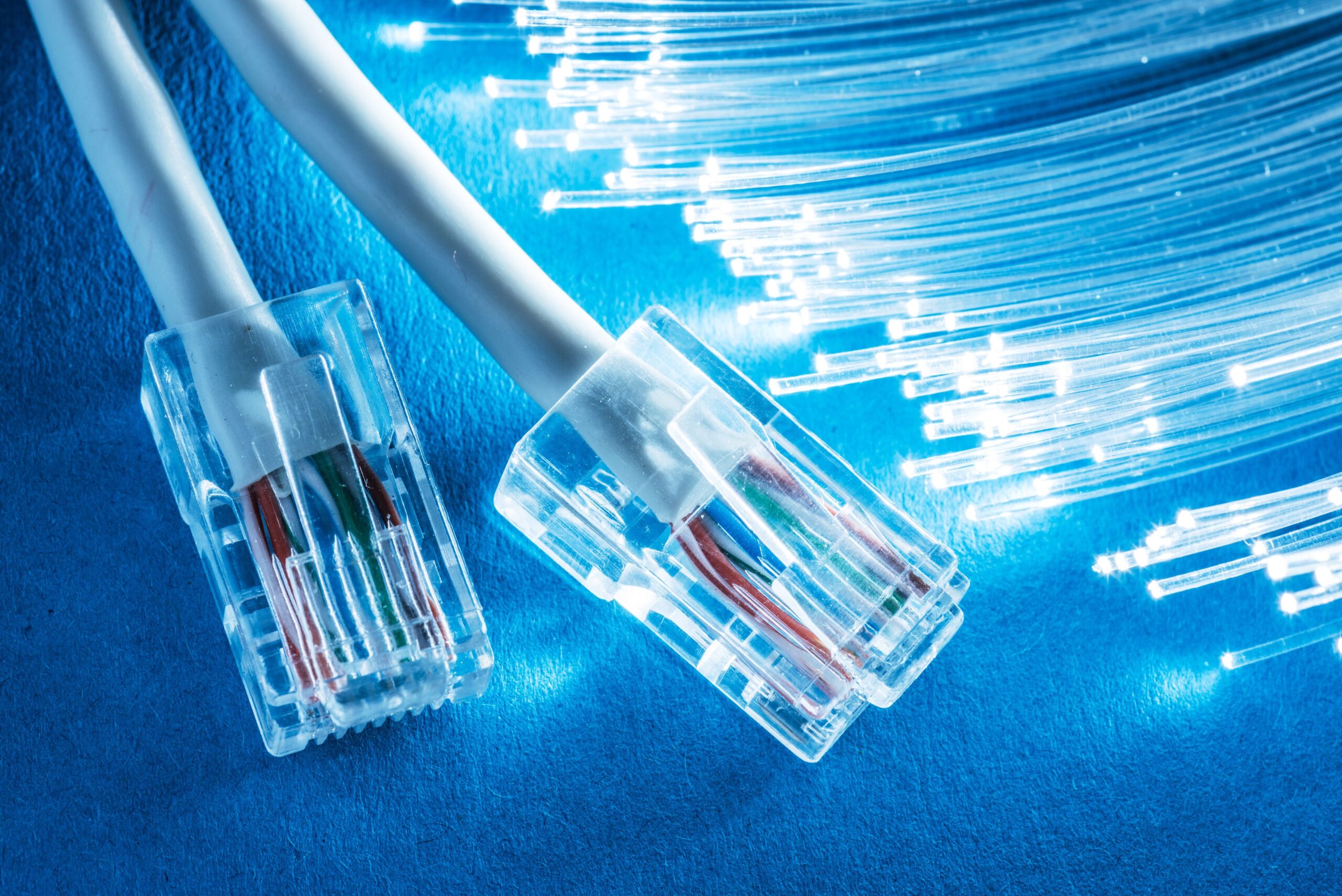
Internet via glass fiber promises a significantly faster data transmission than the cable or DSL. The topic has been discussed for years, but what is actually behind it? And what is the current state in Germany?
Is it worthwhile fiber internet?
In the long term, it is definitely worth it because our surf behavior requires internet faster and faster. However, a lot must be expanded for this.
1. Glass fiber offers high -speed internet

There is almost no life area that has not already been digitized: we transmit music and films, we make purchases and banking online, they store gigantic quantities of images and data in the cloud: we communicate, work, learn and relax in the digital world. Of course, this means that more and more larger data are increasingly navigated. The good old DSL connection quickly reaches its limits. The alternative is called the internet in optical fiber.
Glass fiber is often defined as digital future. At the speed of light through the internet! This is no longer a vision, but already a reality. The data transmission speeds up to 1 Gbit/s must be reached completely new speed size. However, only a few families are actually connected to the fiber optic network. It is still a long way to benefit from the high -speed bandwidth all over Germany.
1.1. How the fiber optic network works
A glass fiber is an extremely thin thread made of melted glass. A hair is also gigantic next to such a fiber. Enable the transmission of data with the help of light. Contrary to the electrical impulses used in copper cables, the data can be transported much faster. And with much less losses, since the bright signals are much less susceptible to electrical or magnetic disorders.
The individual fibers are in bundle and put underground in the form of thick fiber optic cables. They are connected by positioning centers and therefore form a huge fiber optic network.
2. The combined fiber optic and copper lines are the standard
The glass fibers already constitute the basic structure with which the data is transmitted all over the world. However, only very few families have a direct fiber optical connection. As a rule, a certain path from the fiber optic lines to the Wlan router is still covered with copper cables.
The FTTC (Fibra-to-THE-CURD) form standard, which means a fiber optic mixture on the sidewalk. The optical fiber line ends in a distributor connected to the construction of the end user via a copper wire.
The last hundred meters must perform the data via the slower copper line. This is the telephone cable (DSL) or the TV coaxial cable (cable network). Download and 100 Mbit/s in loading are already possible here. However, the bandwidth constantly decreases by increasing the distance from the distribution box.
DSL and VDSL difference
In DSL, all data is transmitted through copper lines. What was considered a quick solution has long been obsolete. In VDSL, the data are at least transported via fiber to the distributor (FTTC) and only on the last counts on copper.
2.1. FTTB & FTTH – The future of the internet in optical fiber
So it is better if the fiber optic line extends directly to the building. This case is called FTTB (fiber-to-the-constructionr). So the building is directly connected to the fiber optic network. Here the data must only cover a very short distance from the copper lines from the basement to the router. Consequently, a significantly faster transmission speed is already possible.
However, the main class is formed FTTH (fiber-to-the-home). Here the fiber optical connection extends directly to the user’s apartment. However, this is extremely rare and can only be found in new areas or few renovations. These families can do without the copper cables and therefore benefit from the infelix high -speed internet.
3. This is what currently appears in Germany
Basically, the large parts of the cable slab in Germany are already made up of optical fibers. However, in most cases, these extend only to the distribution stations and not to the user in the apartment. In theory, just over 4 million families currently have access to a direct fiber optical connection. However, some of these are still unused, since many families still use a DSL or cable connection.
It will certainly take some time before the fiber optic network is expanded throughout Germany and even most of the internet users uses it. In the long term, however, there is no way to get around the internet optical fiber and all current techniques with FTTC are only transition solutions.
3.1. Expansion of optical fiber connections
The problem is that the expansion of fiber optic lines is very expensive and complex. That’s why network suppliers are currently trying to use copper lines for as long as possible. In addition, some also hypothesize that LTE, i.e. the transmission of data via radio, could at some point make the laying cable superfluous.
Telekom in particular promoted the expansion of the internet in optical fiber. But some smaller regional suppliers also want to make the expansion of the fiber optic network. However, he continues to stall. This is mainly due to the fact that VDSL has sufficient transmission speed for most users. So often there is no interest in the fastest lines.
In addition, the civil engineering works needed to throw fiber optic cables are very expensive and also mean great effort in densely populated cities. So there are both conflicts of interest and economic reasons for expansion.
4. Advantages of internet fiberglass
Internet access via optical fiber is possible only if there is a fiber optical connection with the house or even better for the apartment. But access alone is not enough. In addition, there is also a corresponding fiber optic rate and the necessary hardware (optical fiber modem). The rates are offered by all internet suppliers who also sell DSL and CO.
It is possible to verify the availability of a fiber optical connection in the place of residence at Telekom.
In addition to enormously faster download and loading speeds, glass fiber offers numerous advantages:
- It is not subject to errors because it is not disturbed by electrical signals.
- No loss of transmission to great distances or if many users access it simultaneously.
- There are almost no deviations between the booked and effective bandwidth.
latest posts published

5k player-love of another audio/video reader

Search Lookeen 10 desktop replaces Windows Search

How to improve battery life in Samsung Galaxy S6

The perfect game pc in the test – What should really be able to do
How many cups of the CPU really need it

What is the modern configuration guest?

Why do memory stick folders appear as shortcuts?

O & O & Partitionation Particione Profession in version 3

How to find the right calendar app
