
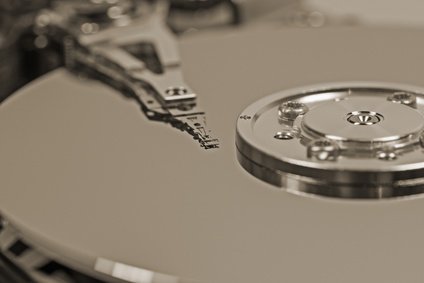
Raid systems should protect rigid discs on the one hand from the failures, on the other hand it is possible to accelerate the system under certain conditions. This is particularly important for companies, but the private user can also benefit from raid technology. In any case, it is important that you first have an overview of the different configuration options and optimally configures the system accordingly.
What does RAID mean?
Raid is the abbreviation of «redundant array of independent discs», in German, for example, a redundant arrangement of independent rigid discs. The user can access this logical unit of several rigid discs as if it were a single plate. With some configurations, the reading and writing processes are considerably faster than a system with a single hard drive. If a plate fails or a technical defect is suffering, it is still possible to access the system, provided that you choose a corresponding level of security. Attention is paid to data security for most users of raid systems.
Hardware or software?
It can therefore be said that a RAID system offers the user the opportunity to face several rigid discs in a grouping. A RAID controller deals with data management and management. A distinction is still made between hardware and software raids. With a hardware raid, an external controller takes on all organizational activities, but the computer takes this activity for a Raid Software. A hardware raid relieves the system and is therefore significantly greater than a raid software.
Overview of the different levels of raid
Overall, there are more than a dozen different raid levels, which represent all different methods. Depending on what matters as a single level and of what your RAID controller can do, the sum of the chances varies. The most common raid levels should only be mentioned here:
- Raid 1: Driving Mirroring
This procedure is also called «mirroring», that is, mirrors. For this you need at least two rigid records. The data are archived on both rigid discs, so the image of one is literally copied. As a result, it is still possible to access all data if the plate fails. In addition, the reading speed is increased enormously, since both plates can be read simultaneously. For a memory with Raid 1, only half of the storage space used is available.
- Raid 2: Hamming System
All data are divided into individual bytes and calculated via the ESC (Error Correction Code) on march and transferred to dedicated rigid discs. However, this method is no longer used in these days, since all modern rigid discs make a calculation of the ECV. - RAID 3: striping byte with dedicated parity
A method rarely used. The individual bytes are distributed to the different rigid discs. However, information on associated equality is written separately on an extra hard drive. However, this procedure is considered relatively insecure, since there is a problem in case of failure of this hard drive. - RAID 4: Striping Block with dedicated parity
Comparable to Raid 3, however, the data are divided into blocks and not in bytes. - Raid 5: Striping Block with equality uniform
Comparable to RAID 4, the equality information is saved, so that the risk of data loss has been significantly reduced to a minimum. If a single hard drive, which is responsible for equality information, cannot, the missing data can be restored using the control amounts. This raid level is often used by file servers. - RAID 6: Striping Block with equality distributed on two plates
Further development of raid 5. Here the data can be restored even if two plates come from the equality network. - Raid 0: striping
The most uncertain raid system more uncertain! Here the panels are simply blocked in a row and therefore in a great guide. If only a single HD fails, all data is lost. However, there is a great advantage in the speed of data. - Raid 1+0 /0+1
A modern raid application and above all for private users, in which the advantages of Raid 0 and 1 (Speed+ Security) are combined.
There are also other raid levels, some for very special or limited purposes.
No substitute for regular backups
Although a raid system sometimes significantly increase data security, a RAID system does not offer 100 % protection and you shouldn’t do without creating backups. Although the probability of data loss is reduced to a minimum or almost completely excluded, it can accidentally delete the data, for example. Only a backup can protect against such supervision. Information on what to do if a raid system should be found here.
In addition to companies with servers where sensitive and important information is found, private users can also use raid systems. Contrary to past times, these systems are very convenient today.
latest posts published

5k player-love of another audio/video reader

Search Lookeen 10 desktop replaces Windows Search

How to improve battery life in Samsung Galaxy S6

The perfect game pc in the test – What should really be able to do
How many cups of the CPU really need it

What is the modern configuration guest?

Why do memory stick folders appear as shortcuts?

O & O & Partitionation Particione Profession in version 3

How to find the right calendar app
