

Libraries belong to essential innovations in Windows 7. However, their meaning and benefits are not so clear for each user, so that they can imagine a new functionality a little more in a more detailed way here. In the article you will also receive suggestions and information on how other sources such as network paths or NAS versions can be included in bookstores on a Windows server (Home).
Presentation of libraries
Up to Windows Vista, the file organization was still connected to their folders: in the «Music» folder, the user was able to put his music, in the «Own Pictures» folder and the files in the «own documents» folder. For each user there are these folders and the general variant «together» for all users of the system. This structure has the disadvantage that the user must organize his content within these folders or that the other archiving sources (for example on another guide another folder with music) must jump manually, would like to access the content.
Windows Vista then introduced a new concept for the organization of user data, which was described there as a virtual folder. However, this was not particularly accessible because you had to start research and this research could therefore be saved as a virtual folder. See suggestion: virtue folders to replace Windows 7 bookstores.
With Windows 7, this thematic storage system of user data in the profile folder is now expanded to include «real» bookstores.
This is basically virtual containers for different types of files, which summarizes the operating system for the user in a library. Therefore it does not matter to the user in which the content is located, since the library provides it as a central starting point to be used. Bookcases behave as real folders compared to the operating system.
The advantages for the user are that can summarize up to 50 different paths in a group of documents (images, music, videos, documents) for bookstore. The different routes were called centrally at some point.
If the folders are included in a library, they will remain in the original place. If a position is specified, the files can also be copied or moved to a library (see the position of the specifications).
Regulates and organizes libraries
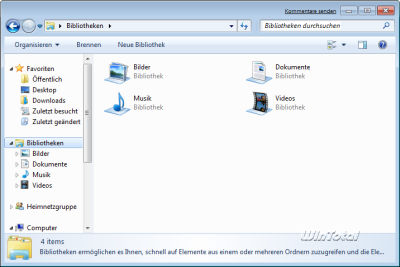
Windows 7 already provides 4 libraries alone (images, documents, music and videos), which are displayed directly in the Explorer when it starts.
 |
|
Libraries under Windows 7 |
The user determines which real folders are included in a library. This can be adjusted via the contextual menu of a bookcase
The user can add further folders to the bookshop here, which are located on the local computer or inside a Windows 7 domestic network group (for other sources on the Internet, see below «Reporting path of the problematic case»).
Another way to include folders to a bookcase is available directly in the contextual folder menu
Here the user can comfortably select in which bookcase the current folder must be recorded or directly creating a new library.
Define the location
Since the virtual folders of the bookstores behave as real folders, they can also record files by dragging or by copying and inserting them. However, this is possible only if at least one folder has been included in the user’s library. The respective standard «public» folder is not enough.
In the following screenshot you can see that the «Own Pictures» folder was subsequently recorded by «F: own files». Only now can the user save files or folders directly in the bookcase. As a real file storage position, the path defined as a position is
Create new bookstores
For a better overview, the user can also create other own bookstores. To do this, move on to the main directory of the bookstores and then go via the context menu -> «New» or via the «New Library» button
A certain type of view is set for each library, which can also be changed if necessary. It is very likely that the «Document» library adapts to types of mixed files such as texts of words, pdf and co., Which is why a different type of «documents» display is also preset.
In addition to internal rigid discs, external rigid discs can also be included in libraries as long as they are also displayed as rigid discs in the workplace. However, the content is available only if the data bearer is also connected and on.
Network paths of cases of problem, modification qualities
Anyone who has their own data on a means of change such as DVD/CD or a USB stick could find the idea of adding them to libraries. However, this usually fails with an error message
The user receives an almost identical error message if he wants to include a network path in a library that is not on a computer with Windows 7 in a home network group.
The reason for this is a special feature of the bookstores: they are based on the data indicated in Windows 7. Only through the index can it provide the various views of the folders for music, images, videos and documents with the destination enlarged information. The content in bookstores is therefore not prepared by the Simple directory calls of the source, but are based on the index of the Windows 7 search function. For this reason, Windows 7 refuses to absorb data that cannot be indexed. This includes not only alternating data carriers, but also in principle the network versions.
This does not apply to the owners of a home network group in Windows 7, since the data on the original calculator have already been indexed here and Windows 7 uses this index.
Windows Server and Windows Vista can also act as data origin if they bring an index service on the server side. Windows 7 is compatible with Windows Search 4.0, available for Windows XP, Vista, Server 2008 and Server 2003. Since Windows Home Server is based on Windows Server 2003, Windows Search 4.0 can also be installed here.
I notify: For the owners of Windows Home Service, the Power Pack 3 offered since 24 November 2009, which not only automatically sets Windows Search 4 on the server, but also automatically integrates the versions in Windows 7 bookstores via the WHS-Connector
If the data have been indexed on the server side, Windows 7 can also include them in bookstores
Help for other network executioners through symbolic connections
Supplement 07.05.2012: The path described below does not work in all cases and is a bit inclined to errors. It is therefore much easier to obtain the goal with the Libary Win7 tool, which undertakes paths in existing or new libraries.
However, the possibility presented is not available for the owners of common nas units or other internet storage solutions. Alternatively, it is possible to make the approval of the offline network available, since this is therefore indexed by the client. However, this would mean that the data would be double, that is, on the client and the approval of the network.
The creation of symbolic connections with the command line tool is a solution here mklink A. This is basically a reference to another source that can be a directory, unity or approval of the different network.
First of all, a folder is created on a local hard drive which later records the symbolic connection to the network source, in our example «Network Data» on the unit F:
In the 2nd step, the command prompt is started with the administrator’s rights and a symbolic connection is created with Mklink.
MKLINK F: Data Network Music Wservermusik /D
Create a «Music» folder in the «Data Network» folder (but the «D» parameter), which refers as a symbolic connection to the «Music» directory to the «WTERSER» network source
According to this scheme, also, symbolic connections to images and documents can be created in the «Data Network» folder (e.g. MKLINK F: Photos WTSPERFOTOS /D data network network).
These symbolic connections can now be included in Windows 7 bookstores.
With this solution not supported by Microsoft, however, it is important to consider that the data must now be indexed through the network, which sometimes causes a high load load. If this alternative solution is used on multiple computers, the data must be indexed by each computer on the network, which increases the load again. Furthermore, the changes to the bookstores (e.g. renowning new files on the network path) are not immediately visible, since the display is based on the index. For file operations of all kinds, the user should therefore rather work directly on the source (network drainage) instead of in the library.
Further connections
Blog by Daniel Melanchon-Network Path and Guide in libraries
Wintotal – Windows Search 4.0
Wintotal Tipparchiv – Virtual folder of a Windows 7 bookstores
Wikipedia – Symbolic connections
Home Server Blog – Power Pack 3 Für Windows Home Server
Microsoft-Information on Windows Home Server Power Service Pack 3 Updates
latest posts published

5k player-love of another audio/video reader

Search Lookeen 10 desktop replaces Windows Search

How to improve battery life in Samsung Galaxy S6

The perfect game pc in the test – What should really be able to do
How many cups of the CPU really need it

What is the modern configuration guest?

Why do memory stick folders appear as shortcuts?

O & O & Partitionation Particione Profession in version 3

How to find the right calendar app
