

Windows Update It is a curse and a blessing at the same time. While Microsoft is trying to keep all Windows installations updated, there have been Windows 10 for domestic users there are no opportunities to refuse updates And with it the defect, even that Find the road to the computer that are mutually checked updates. In the following article we describe how you areUninstall Olche Windows updates again, even if Windows no longer starts.
- Not all mistakes on your windows must be due to a Windows update.
- Before uninstalling an update again, check the update in the KB item by Microsoft if the error is described there and a speaker can be documented without uninstalling the update.
- The regular protection of the images, ideally before each Microsoft Patchday, which is launched every 2nd Tuesday in a month, protects her from bad surprises.
Microsoft took control of Windows Update from Windows 10
As a user, for example, they were able to determine in Windows 7, for example, If and which one Updates to go up to your PC. With Windows 10 Microsoft has this for the user However, there is at least in the domestic edition -And thus decides the possibility for yourself which monthly updates and even great features of functionality increase on your PC.
Updates in Windows 10: All information on updates and updates in Windows 10 and on the question about how to block also under Windows 10 Home updates can be used in updates and updates of the articles in Windows 10.
As a rule, the user has only the possibility of Updates To accept or with tools such as StopupDates10 or Windows Update Blocker generally blocks, What we expressly recommend. Microsoft’s patch day shows that almost monthly Also Critical errors in the windows and other Microsoft components such as .NET Framework, Internet Explorer or Edge They were fixed.
Search for obstinate updates
If you find problems after one or more updates and could be due to one of the updates, you should first do research on the update. To do this, you have to check which updates were installed the last time during the update course. In Windows 7 the Update In the control panel in Windows Update
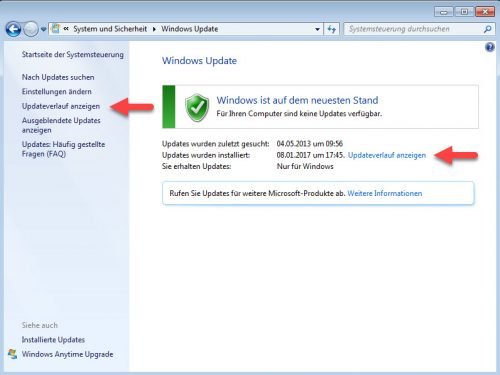
In Windows 10, on the other hand, the refresher course is in the settings -> Update and Security a Windows Update to find.
The course shows which updates were the last time. Windows 10 separates between Functional updates (The Big Windows 10 versions such as the Windows update 10 October 2018) e Quality updates To remedy the security gaps or Windows functional problems.
Each update in the bracket leads a basic number of knowledge (KB number). It is possible to use the item existing via https://support.microsoft.com/de-do/help/4467702/ Call. There you will find a description of the update and a section Known problems with this update OR. Known problems in this updateIf the KB item has not yet been translated.
Uninstall the problematic update
In the simplest case, you can simply uninstall the update related to you. The Windows 10 refresher course offers a connection directly under the header, which refers to the control system -> programs and features -> installed updates.
In the update list, you can uninstall the update in question via the context menu.
Dissemination of the case of the problem: However, uninstalling is possible only if the cleaning of the disk (Cleanmgr) has not already deleted the necessary updating files.
Uninstalling updates via the command line
Unfortunately, you will not find all the updates in the list of updates installed. For example, cumulative updates are missing from Windows 10, which Microsoft extends monthly for the various editions.
In this case, you have to make friends with the Windows command line and start as an administrator.
Command line as administrator: The command line (cmd) with the administrator’s rights works with the combination of keys [STRG]+[ALT]+[ENTER] OR [Windows]-Sstro -CMD – [STRG]+[SHIFT]+[ENTER]. Or Start menu – Search bar: [Programme/Dateien durchsuchen] (Win7) or enter the «CMD» start menu for Windows 10 – CMD.EXE – Click Cmd.exe on the right – «Perform as administrator»
So give the command there
Wusa /uninstall /kb:2807986 /log:%homepath%Desktopwusalog.evtx
A. The number behind KB must be adapted accordingly.
The command also places a Record the file on the desktop user. This includes two files: one file with the EVTX end and another with the .dpx ending.
By clicking on the EVXT file, this is in Events display loaded. You can view the items of the protocol for uninstalling here.
Since the refresher course does not take into account the fact that a Microsoft update has been replaced by a more recent version, so there is no longer any more, an attempt to uninstall can occur.
With the command
dism /online /get-packages
You can all Really installed updates.
Uninstall updates with Windows, which is no longer started
In very few cases it happens Windows no longer starts after a Windows update. In this case, it is necessary to start the system using a system repair data or your Windows En environment from the command prompt (in the extensive options). You can also use a Windows installation vector and here to «Welcome dialog» with Shift+F10 starts the command prompt.
To list the installed updates, enter the following command in the command line:
dism /image:e: /get-packages /scratchdir:e:
To adapt You are here the letter «and» from the installation of Windows.
Windows then lists all the installed updates of the questioned windows.
With the command
dism /image:e: /remove-package /packagename:Package_for_RollupFix~31bf3856ad364e35~amd64~~16299.492.1.9 /scratchdir:e:
You can uninstall individual Windows installation packages, so the Name of the 1: 1 package to be covered and the route must be adapted to the Windows partition (here e).
Start a new installation of updates
In order to prevent the update that has just been reinstalled again, it is necessary to hide this update. While Windows 7 in Windows Update has the option to hide individual updates via the contextual menu of updates found, Microsoft has removed this function in Windows 10.
In Windows 10, on the other hand, you have to start the «Wushowhide.diagcab» tool, which is described in the KB3073930 knowledge item and can also be downloaded there for Windows 10.
After a short search, that updates have not been installed, it is possible to hide the updates or view already hidden updates.
Under Hide updates You can choose which new updates, not yet installed you want to hide and continue.
If you want to remove the restriction again, you can also cancel this with the tool under the menu item «Show hidden updates».
Conclusion
Microsoft offers tools to defend yourself from problematic updates. However, these have not been easy to use by Windows 10 and require help from articles like this.
latest posts published

5k player-love of another audio/video reader

Search Lookeen 10 desktop replaces Windows Search

How to improve battery life in Samsung Galaxy S6

The perfect game pc in the test – What should really be able to do

How many cups of the CPU really need it

What is the modern configuration guest?

Why do memory stick folders appear as shortcuts?

O & O & Partitionation Particione Profession in version 3

How to find the right calendar app
